Method
How do I make infused sugar?
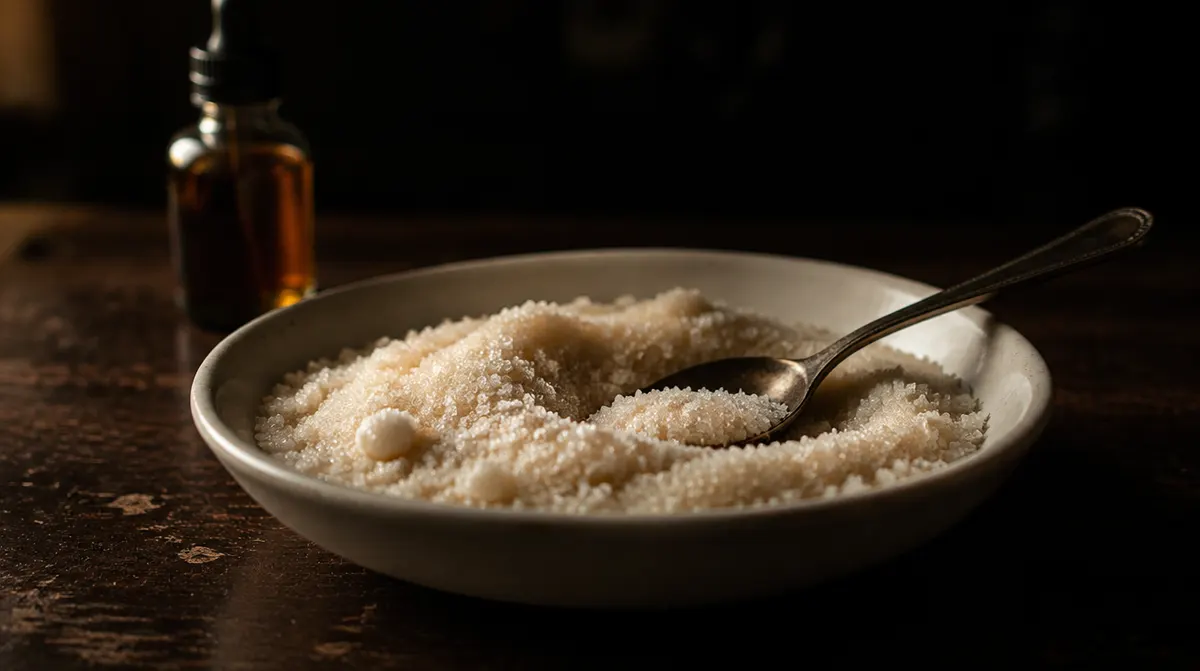
Sugar has no fat and no alcohol in it, so nothing dissolves into it the way it does into butter. The trick is to use alcohol as a carrier and then take the alcohol away: dissolve a tincture over sugar, spread it thin, and let it dry. What remains is coated rather than infused, but it doses like a dream — it stirs into coffee, sprinkles over anything, and brings no fat with it.
How to make it
- 01
Decarb the flower. Break it up coarsely by hand or with a grinder, spread it in a single even layer on a parchment-lined sheet, and bake at 240 °F for 30–45 minutes.
This converts THCA into THC — without it, most of what you have stays inactive. 240 °F converts 85–95% of what is available. Longer is not safer: past the peak, THC starts turning into CBN and the loss does not come back. Set a timer.
- 02
Make a tincture first: cover the decarbed flower with high-proof alcohol in a sealed jar and leave it 12–24 hours in the freezer, shaking when you pass it.
There is no direct route here. Sugar is neither fat nor alcohol, so nothing dissolves into it — the alcohol does the extracting and then leaves.
- 03
Strain the tincture through cheesecloth, letting it drip rather than squeezing.
- 04
Pour the strained tincture over granulated sugar in a wide dish and stir until every crystal is wet. Roughly one cup of sugar per half cup of tincture.
Wide and shallow matters more than it sounds: the alcohol has to evaporate, and a deep bowl traps it.
- 05
Leave it somewhere warm and well ventilated until completely dry — usually a day or two. Stir it every few hours to break the crust.
No heat, no oven, no hair dryer. You are evaporating alcohol, which is flammable, and heat costs you potency at the same time. If it still smells of alcohol it is not finished.
- 06
Break up the clumps with a fork or a short blitz in a processor, then store airtight and labeled.
It will cake as it dries; that is normal. Because it brings no fat, this is the right way to dose coffee, tea or a glass rim and the wrong way to dose anything that needs fat for structure.
Notes on sugar
- Make a tincture first. There is no direct route: this method is entirely dependent on having alcohol to carry the cannabinoids onto the sugar and then leave.
- Dry it somewhere warm and well ventilated, never with heat. You are evaporating alcohol, which is flammable, and heat costs you potency at the same time.
- Break up the clumps once dry — it will cake. A quick blitz or a fork gets it back to loose crystals.
- Because it carries no fat, it is the right way to dose coffee, tea or a rim on a glass, and the wrong way to dose anything that needs fat for structure.
How strong will it be?
That depends entirely on your flower, and this page cannot tell you. What it can tell you is the shape of the answer: of the cannabinoid you start with, decarb activates most of it and this method transfers roughly 55–72% of that into the sugar.
Put your own numbers in and you get a range in milligrams per tablespoon, with the assumptions printed beside it — then every recipe here rescales itself to match.
Questions people ask
- Why not just infuse sugar directly?
- Because there is nothing in sugar for cannabinoids to dissolve into. Fat and alcohol both work as solvents; sugar crystals do not. Anything you did by simmering flower with sugar would coat the outside at best and mostly end up on the strainer.
- Does it taste of alcohol?
- Not once it is properly dry. If it does, it is not finished — spread it thinner and give it longer. Rushing this step with heat is how people lose both the flavor and a chunk of the potency.
- Can I bake with it?
- Yes, and it is a neat way to dose something without introducing a fat you did not want. Bear in mind it goes through the oven, so treat it like any baked infusion rather than expecting the full tincture strength to survive.