Method
How do you make FECO at home?
FECO is what is left when you make a strong alcohol tincture and then evaporate all of the alcohol: a dark, tar-thick oil holding nearly everything the alcohol pulled out of the flower. RSO is the same idea under its inventor's name, though older RSO recipes call for naphtha or isopropyl alcohol, and neither is food. Made the way below, with food-grade alcohol, it is the most concentrated thing you can make in a kitchen, and the only method here where the dangerous part is the process rather than the dose.
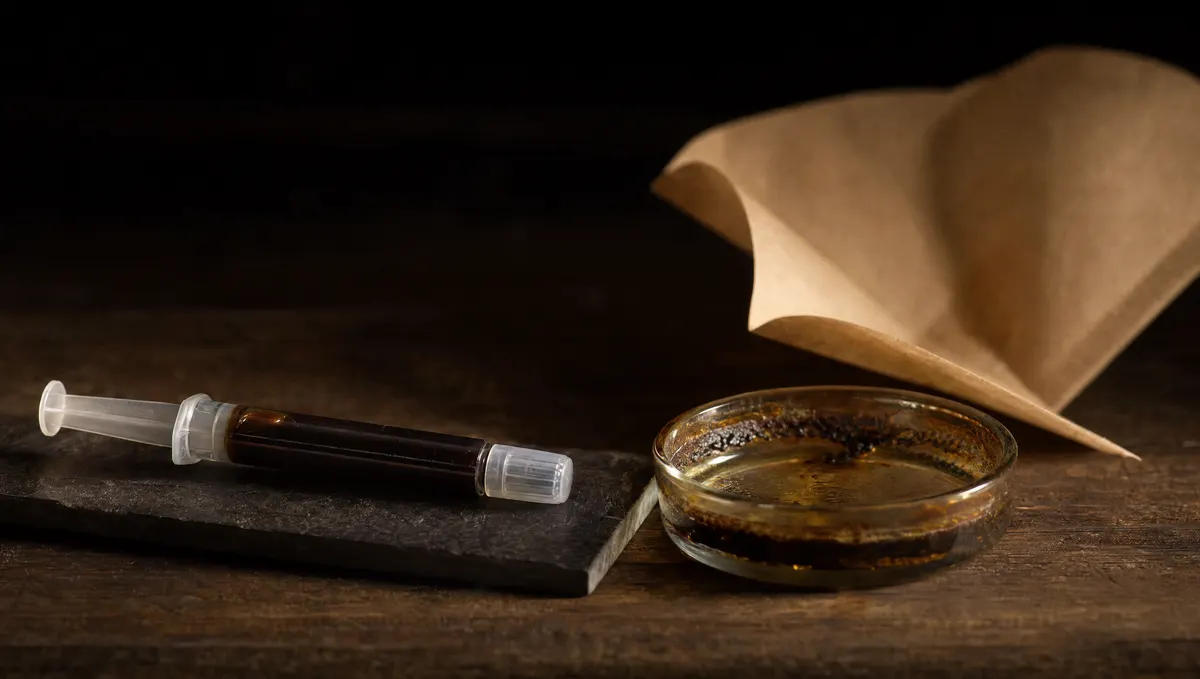
How to make it
- 01
Decarb the flower. Break it up coarsely by hand or with a grinder, spread it in a single even layer on a parchment-lined sheet, and bake at 240 °F for 30–45 minutes.
This converts THCA into THC — without it, most of what you have stays inactive. 240 °F converts 85–95% of what is available. Longer is not safer: past the peak, THC starts turning into CBN and the loss does not come back. Set a timer.
- 02
Freeze the decarbed flower and a bottle of food-grade 190-proof alcohol separately for a few hours.
Cold keeps chlorophyll and plant waxes in the flower. Here that matters twice over: whatever comes across is about to be concentrated along with everything else.
- 03
Combine them in a sealed jar at roughly 28 g of flower per cup of alcohol, and return it to the freezer for 12–24 hours, shaking it whenever you pass.
This is the tincture step exactly. More alcohol does not extract meaningfully more; it only gives you more to evaporate, which is the slow and risky part.
- 04
Strain through cheesecloth, then through a coffee filter, into a wide, shallow heat-proof glass dish, such as Pyrex. Let it drip; do not squeeze.
The coffee filter catches the fine particulate cheesecloth lets through. In a tincture that is a little grit; in FECO it ends up concentrated in the oil.
- 05
Leave the dish to evaporate at room temperature in a well-ventilated room with no flame, pilot light, heater or spark in it, loosely covered against dust, until it is a thick syrup. Expect days, not hours.
Alcohol vapor catches fire at room temperature and is heavier than air, so it settles and drifts along counters and floors. A gas stove's pilot light across the room is close enough. Patience is the safety measure here.
- 06
Finish it over hot water: set the dish in a larger pan, pour in just-boiled water from a kettle, and stir until it stops bubbling and no longer smells of alcohol. Refresh the water as it cools.
The last of the alcohol, and the water 190-proof carries, leave very slowly once the oil is thick. The kettle stays on the counter, away from the dish. Never on a stovetop, a hot plate or in a rice cooker — each one puts a heat source directly under the vapor.
- 07
While it is still warm and runny, draw it into an oral syringe, cap it, and label it with the date and the batch total from the calculator. Store it cold and dark.
Note how many milliliters are in the syringe. The batch total divided by that is your milligrams per milliliter, and every dose comes from that number.
Notes on FECO
- Food-grade alcohol only: 190-proof grain alcohol such as Everclear. Never rubbing alcohol (isopropyl), naphtha, butane or any hardware-store solvent. None of them is made to be eaten, and you are about to concentrate whatever is left of it.
- Alcohol vapor catches fire at room temperature and is heavier than air, so it pools low and drifts toward pilot lights, burners, heaters and cigarettes. Evaporate it with no flame or spark anywhere in the room.
- It is far stronger by volume than anything else on this site. A single drop can hold more than a standard edible dose, so it is measured in tenths of a milliliter from an oral syringe, never by eye.
- It works best as an ingredient: stirred into warm cannabutter or oil to strengthen a batch, or into a recipe's fat. The concentrate calculator does that math.
How strong will it be?
The extraction is the tincture step, so the same figures apply: decarb activates most of what your flower has, and the cold alcohol wash pulls roughly 65–85% of that out. Evaporating the alcohol does not change the total — it puts all of it into a few grams of oil, less the tarry film that stays on the dish.
Run the calculator as a tincture: its figure for the whole cup is your batch total in milligrams. Divide that by the milliliters in your syringe for a dose per milliliter. If you weigh the finished oil, the total divided by ten times the grams is its THC percentage, which is the figure the concentrate calculator asks for.
Questions people ask
- What is the difference between FECO and RSO?
- Mostly the name and the solvent. Both are made by washing cannabis in a solvent and evaporating it off. RSO is named after Rick Simpson, whose early instructions used naphtha or isopropyl alcohol, neither of which is food. FECO is the name usually given to the food-grade alcohol version, which is the only one this site describes.
- Is FECO the same as a tincture?
- It starts as one. A tincture keeps the alcohol; FECO removes it, so the same cannabinoid ends up in a few grams of oil instead of a cup of liquid. Far stronger by volume, no alcohol to taste, and much harder to measure.
- Can I evaporate it in a rice cooker?
- Not the way this page does it. Plenty of guides use one, but a rice cooker puts a heating element directly under a pan of evaporating alcohol, and alcohol vapor ignites easily. Evaporating at room temperature and finishing over hot water from a kettle keeps the heat source away from the vapor.
- Is store-bought FECO already decarbed?
- Not necessarily. Some producers decarb as a separate step after the solvent is removed, which tells you evaporation alone did not do it. Check the label or lab report for THC against THCA. What you make on this page is decarbed, because the flower is decarbed first.
How long it keeps, and why infused fat belongs in the fridge or the freezer: storage and shelf life.